
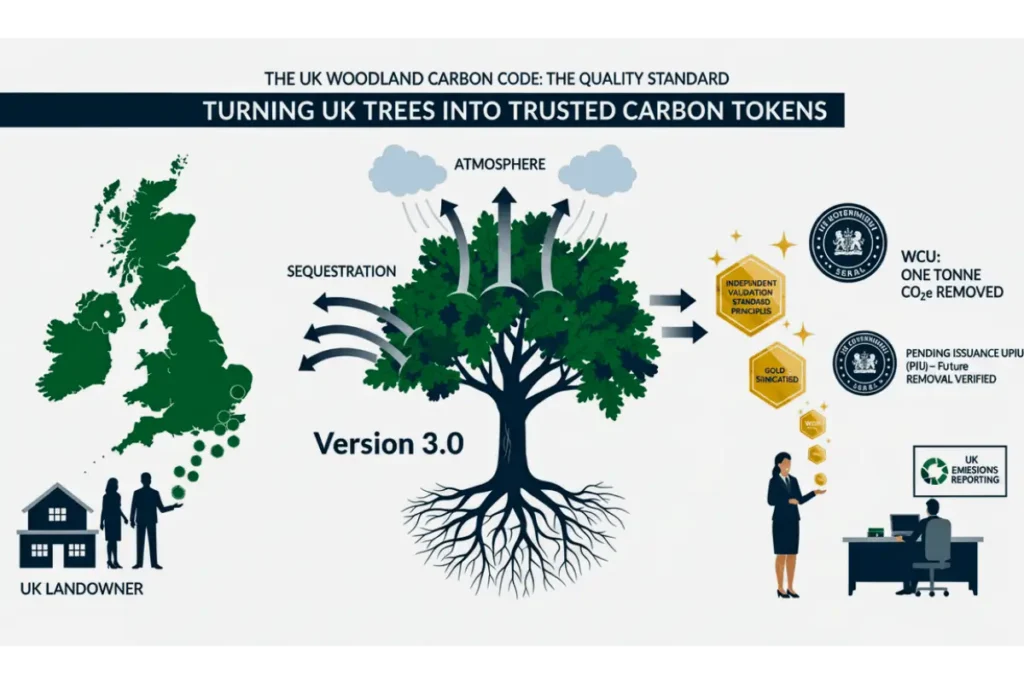
If you own land in the UK and want to plant trees, one question is worth asking before you put the first sapling in the ground — can those trees generate verified carbon credits that companies will actually pay for?
The answer depends entirely on whether your project meets the standards set by the Woodland Carbon Code.
The Woodland Carbon Code is the UK’s official quality assurance standard for woodland creation projects. It has been running since 2011, is backed by all four UK governments, and is the only standard that allows landowners to generate independently verified carbon units from new woodland planting anywhere in England, Scotland, Wales, and Northern Ireland.
Following the landmark launch of Version 3.0 in August 2025, the UK carbon market has entered its most commercially viable era yet. While previous iterations felt like a regulatory hurdle, the 2026 landscape focuses on making carbon finance a primary income stream for farms, rather than just a secondary grant.
Why the WCC is Your Most Important Reforestation Tool
At Planettools.org, we categorize hardware and software, but the Woodland Carbon Code (WCC) is the ultimate financial tool. It transforms “planting trees” from a cost-sink into a high-yield environmental asset.
In 2026, the code functions as the infrastructure for your project. Without it, you are just planting trees; with it, you are building a verified carbon-sequestration engine that attracts institutional investment.
Key Updates of Woodland Carbon Code 2026
- June 30, 2026 Deadline: The final date to submit projects under the older Version 2.2 rules; all new registrations must then use Version 3.0.
- Price Surge: 2026 market data shows high-quality credits (PIUs) trading at £27–£33+ per tonne, a significant rise from 2024 levels.
- 10-Hectare “Small Woods” Rule: Version 3.0 simplifies the registration toolset for farms and smallholdings up to 10 hectares.
- No “Double-Counting”: The January 2026 update prohibits claiming carbon credits on land already legally committed to Biodiversity Net Gain (BNG) or Nutrient Neutrality.
- Digital Verification: The WCC now accepts Satellite and LiDAR data from modern monitoring tools to verify carbon sequestration, replacing costly manual surveys.
- UK-Only Constraint: Credits remain strictly locked to UK-based emissions, ensuring corporate investment stays within local nature-recovery projects.
How the Woodland Carbon Code Works
The code operates on a straightforward principle. Trees absorb carbon dioxide as they grow. The Woodland Carbon Code provides a standardised, independently verified way to measure exactly how much carbon a new woodland removes from the atmosphere — and converts that removal into tradeable carbon units.
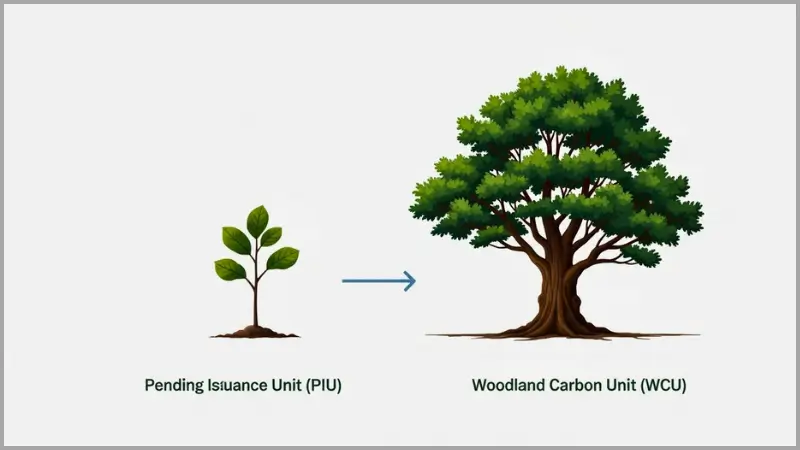
It offers two distinct types of units:
- A Woodland Carbon Unit represents one tonne of carbon dioxide equivalent that has already been removed from the atmosphere by a verified project — the real, guaranteed credit
- A Pending Issuance Unit is a promise to deliver a Woodland Carbon Unit in the future, based on an independent validation of predicted carbon removal — sold early to give landowners upfront income during the expensive establishment phase
A new native woodland can absorb 300 to 400 tonnes of carbon dioxide equivalent per hectare by the time it reaches 50 years old. That carbon capture is spread across the project’s lifetime, with units issued in tranches as the trees grow and verifications confirm the real sequestration happening on the ground.
Who Manages the Code and Why It Has Credibility
The Woodland Carbon Code is managed by Scottish Forestry on behalf of the Forestry Commission, the Welsh Government, the Scottish Government, and the Northern Ireland Forest Service.
This is not a private standard run by a carbon market company. It is a government-backed quality assurance framework with publicly accountable oversight — which matters enormously when professional buyers are deciding whether to trust the carbon units they purchase.
The code aligns to national and international standards including the UK Forestry Standard, BSI’s Nature Investment Standards, and the Integrity Council for the Voluntary Carbon Market’s Core Carbon Principles. It is also endorsed by the International Carbon Reduction and Offset Alliance.
That combination of government backing and international endorsement gives it a level of credibility that purely commercial carbon standards struggle to match in the UK context. As of August 2025, projects validated under the code have created 38,705 hectares of woodland predicted to sequester over 13 million tonnes of carbon dioxide equivalent across their lifetimes.
What Changed in Version 3.0
Version 3.0 launched on 1 August 2025. It incorporates insights from recent research and consultation feedback and aligns with national and international frameworks. The changes are designed to make the Woodland Carbon Code more accessible, practical, and commercially viable for the land management sector.
The full announcement from Scottish Forestry sets out the reasoning behind the update clearly. The most significant changes affect three areas:
Small woodlands and farms gained easier access.
Version 3.0 increases the threshold for using the small woods process to ten hectares. Previously this streamlined route was only available to much smaller projects. Raising the threshold means a significantly larger number of farms, crofts, and smallholdings can now access the code through a simpler process with reduced administration and monitoring requirements.
This directly addresses one of the most consistent pieces of feedback from smaller landowners — that the code was designed for large commercial forestry operations and was too complex for farms and smallholdings to navigate without specialist help.
Crofting land and tenanted land gained new eligibility.
Version 3.0 extends the code’s reach to tenanted crofts and common grazing land in Scotland. The updated code introduces specific provisions for common grazing projects, requiring all graziers to agree and sign a commitment statement, with units held in a single account managed by a representative party.
Economic data and cashflow tools were updated.
The new version uses the latest economic data to reflect the practical realities of land management in today’s business climate. The cashflow model that helps project developers plan their income has been updated to reflect current land management costs and carbon market prices, making financial planning more realistic from the outset.
Transition arrangements run until June 2026.
The clock is ticking on the transition period. Landowners have until June 30, 2026, to submit projects under the older Version 2.2 rules. From July 1, 2026, every new registration must strictly adhere to the Version 3.0 methodology, which includes more rigorous soil carbon sampling but offers higher potential unit issuance for native broadleaf projects.
The Verification Process Step by Step
Understanding how a project moves from planting to verified carbon units helps landowners plan realistic timelines and financial expectations.
Registration comes before planting begins. A project must register with the Woodland Carbon Code before work starts on site. Registering after planting has already begun disqualifies a project from generating credits for trees already in the ground.
Validation confirms the plan is credible. An accredited Validation and Verification Body reviews the project design document, confirms land eligibility, checks that the project is additional — meaning it would not happen without carbon income — and validates the predicted carbon removal calculations. This step must be completed within three years of registration.
Pending Issuance Units are issued after validation. Once validated, the predicted future carbon removal gets converted into Pending Issuance Units and listed publicly on the UK Land Carbon Registry. These can be sold immediately to generate upfront income during the expensive early years of establishment.
First verification happens at year five. The year five check is a lighter-touch review designed to confirm the woodland is establishing as planned. It serves as an early opportunity to catch any problems before the next full verification cycle.
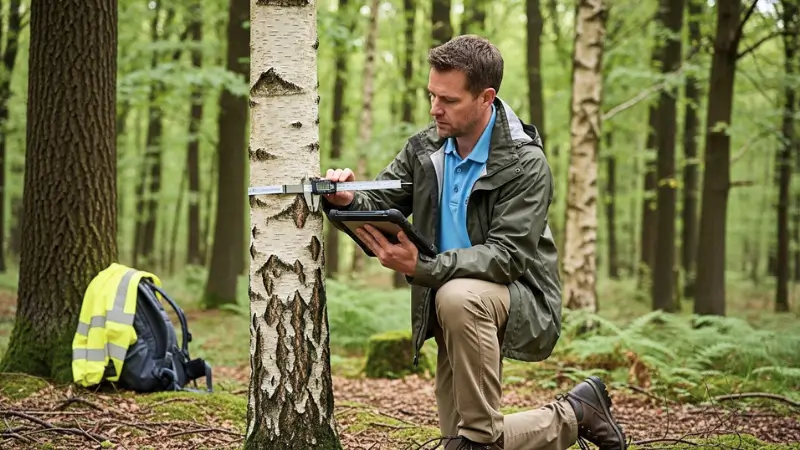
Full verifications continue every ten years. Independent verifiers return approximately every decade to confirm actual carbon sequestration against predictions. Each successful verification converts Pending Issuance Units into fully verified Woodland Carbon Units — the guaranteed, sellable credits that companies use in their emissions reporting.
Projects run for a minimum of 40 years. The long duration reflects the reality that trees take decades to reach their full carbon capture potential. Landowners commit to maintaining the woodland and monitoring it throughout the full project period.
What Landowners Actually Earn
The financial case for participating in the Woodland Carbon Code depends on a combination of carbon unit income, government grants, and timber revenue — all of which can run alongside each other.
By Q2 2026, the market has matured significantly. While 2024 saw averages around £23, current 2026 market data suggests Pending Issuance Units (PIUs) now frequently trade between £27 and £32 per tonne. This price hike reflects growing corporate demand for ‘Gold Standard’ UK-based removals that meet the latest Integrity Council (ICVCM) requirements.
Landowners no longer simply ‘receive’ payments; they actively negotiate forward-contracts with corporate buyers who prioritize locally-sourced, government-backed carbon removals.
Beyond carbon income, the Woodland Carbon Guarantee offers an additional layer of financial security for English landowners. It gives landowners the option to sell woodland carbon units to the government every five or ten years up to 2055 to 2056 at an agreed guaranteed price that is index-linked for the life of the contract.
This government buyback guarantee removes a significant element of market risk. Landowners who want certainty over their income can lock in a guaranteed price rather than depending on future voluntary carbon market conditions.
What Companies Use the Code For

On the buying side, the Woodland Carbon Code serves a different but complementary purpose.
Large UK organisations are required by law to report their greenhouse gas emissions. Once they have reduced emissions in line with science-based targets, they can compensate for unavoidable residual emissions — from fleet vehicles, business travel, or industrial processes — by purchasing Woodland Carbon Units.
The code specifically limits this use to UK-based emissions. Woodland Carbon Units cannot be used to compensate for emissions generated outside the United Kingdom. This geographic restriction ensures that carbon money spent on UK woodland creation stays connected to UK emissions, rather than being used to offset global operations at a distance from the forests generating the credits.
Pat Snowdon, Head of Economics and Woodland Carbon Code at Scottish Forestry, described Version 3.0 as reflecting a commitment to continuous improvement — ensuring the code remains a trusted standard as the UK carbon market matures and buyer scrutiny of credit integrity increases.
How the Woodland Carbon Code Compares to Global Standards
For landowners or businesses familiar with global carbon standards like Verra’s Verified Carbon Standard or the Gold Standard, it is worth understanding how the Woodland Carbon Code sits alongside — rather than in competition with — those frameworks.
The key difference is geographic scope. The Woodland Carbon Code operates across the UK only. Verra and Gold Standard operate globally and are used for projects in tropical forests, developing countries, and international voluntary carbon markets.
For UK woodland creation, the Woodland Carbon Code is the appropriate standard. It is specifically calibrated for UK species, UK climate conditions, UK land tenure arrangements, and UK regulatory requirements. Both share the same foundational principles — additionality, permanence, independent verification, and public registry listing. The implementation is simply UK-specific.
To understand how the global verification process works alongside the Woodland Carbon Code, read our full guide on how tree-planting projects are verified.
Is the Woodland Carbon Code Right for Your Land
The code suits a specific type of project. Understanding eligibility requirements before investing time in a project design saves considerable effort.
To be eligible a project must:
- Be located in England, Scotland, Wales, or Northern Ireland
- Involve new woodland creation — not management of existing woodland
- Demonstrate additionality — it must not be financially viable without carbon income
- Register before planting begins
- Not involve compensatory planting to replace trees felled for development
- Commit to a minimum project duration of 40 years
The 2026 guidelines provide a stricter ‘Additionality’ test. Specifically, the code now clarifies that if your land is already legally committed to Biodiversity Net Gain (BNG) or Nutrient Neutrality schemes, you cannot ‘double-count’ those same trees for carbon credits unless the carbon income is the deciding factor for the project’s scale or species mix.
The Version 3.0 changes have expanded eligibility meaningfully for smaller farms and crofting land. But the core requirement — that the project would not happen without carbon finance — remains non-negotiable. Projects that would be planted regardless of carbon income do not qualify.
A Standard That Is Quietly Working
The Woodland Carbon Code is not the most visible part of the global conversation about reforestation and carbon markets. It operates quietly in the background of UK land management, connecting farmers who want to plant trees with businesses that need to compensate for unavoidable emissions.
But what it represents matters. It is a government-backed, independently verified, publicly accountable standard that has put nearly 39,000 hectares of new woodland in the ground since 2011 — woodland predicted to remove over 13 million tonnes of carbon dioxide from the atmosphere across its lifetime.
The Woodland Carbon Code isn’t just a policy—it’s a performance standard. To succeed in 2026, you need to pair the WCC’s financial framework with the right physical and digital tools.
Whether you need carbon yield calculators to predict your PIU issuance or automated planting hardware to lower your establishment costs, the goal remains the same: high-integrity reforestation.
Understanding where the Woodland Carbon Code fits in the broader reforestation picture helps put it in context. Read our guide on the reforestation benefits that well-managed woodland projects deliver beyond carbon alone, and explore what reforestation actually means before deciding whether a project like this is the right fit for your land or business.
Frequently Asked Questions Related to Woodland Carbon code:
What is the Woodland Carbon Code?
The Woodland Carbon Code is the UK’s official quality assurance standard for woodland creation projects. Managed by Scottish Forestry on behalf of all four UK governments, it allows landowners to generate independently verified carbon units from new woodland planting and gives businesses a credible way to compensate for unavoidable UK-based emissions.
When did Version 3.0 launch?
Version 3.0 launched on 1 August 2025. Projects already in development can continue using Version 2.2 until 30 June 2026. After that date all new submissions must use Version 3.0.
What are Woodland Carbon Units?
A Woodland Carbon Unit represents one verified tonne of carbon dioxide equivalent removed from the atmosphere by a Woodland Carbon Code project. A Pending Issuance Unit is a promise to deliver a future Woodland Carbon Unit, sold early in a project’s life to generate upfront income during the establishment phase.
How much can a landowner earn from the Woodland Carbon Code?
A native woodland absorbs around 300 to 400 tonnes per hectare over 50 years. While 2024 saw averages around £23, current 2026 market data suggests Pending Issuance Units (PIUs) now frequently trade between £27 and £32 per tonne. The Woodland Carbon Guarantee gives English landowners a government-backed index-linked buyback option for added financial certainty.
Who can apply for the Woodland Carbon Code?
Any landowner in England, Scotland, Wales, or Northern Ireland creating new woodland on previously unwooded land. The project must be additional — not financially viable without carbon income — and must register before planting begins. Version 3.0 has expanded eligibility for smaller farms up to ten hectares and crofting land.
How does verification work under the code?
Projects are validated by an accredited independent body before or shortly after planting. First verification happens at year five and full verifications follow every ten years. Each verification converts Pending Issuance Units into fully verified Woodland Carbon Units listed publicly on the UK Land Carbon Registry.
How does the Woodland Carbon Code compare to Verra or Gold Standard?
The Woodland Carbon Code is UK-specific and cannot be used for projects outside Britain. Verra and Gold Standard are global standards used for international projects. For UK woodland creation, the Woodland Carbon Code is the correct choice — calibrated specifically for UK conditions, species, and regulatory requirements, with strong credibility among UK carbon buyers.
Can I combine the Woodland Carbon Code with the Sustainable Farming Incentive (SFI)?
Yes. In 2026, the government actively encourages “stacking.” You can receive SFI payments for land management actions while simultaneously generating carbon units under the Woodland Carbon Code, provided you meet the additionality tests.