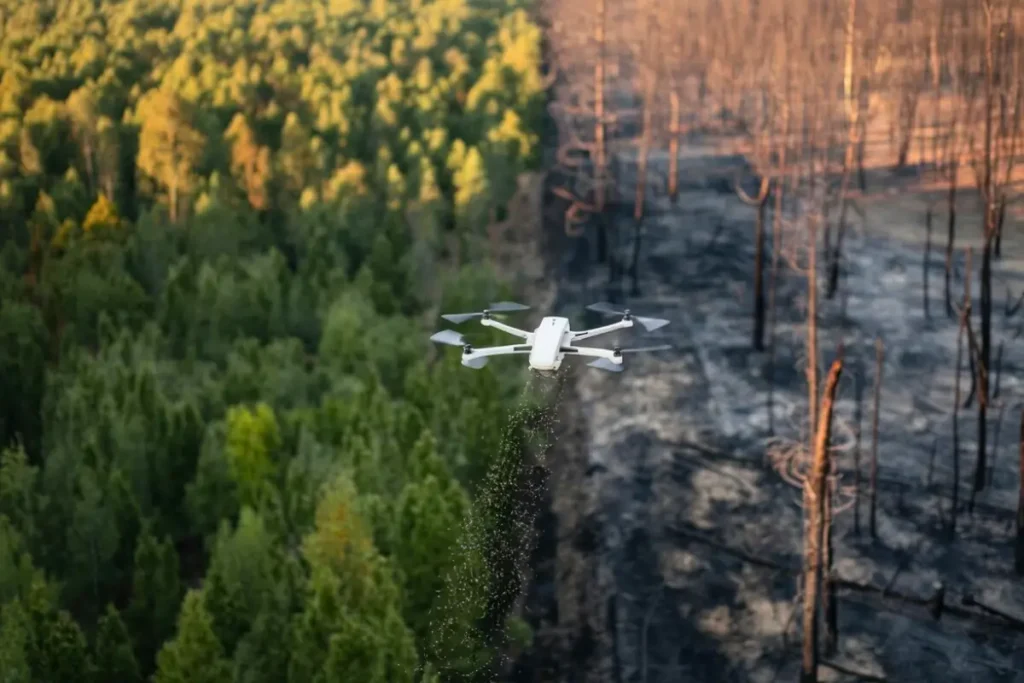
Choosing how to replant a forest is not just an environmental decision — it is a logistical one. The tools you pick will determine your costs, your timeline, and how many of those trees actually survive. Two camps dominate the reforestation space right now: drone seeding systems and traditional hand-planting crews. Each approach works well in the right situation. Each fails badly in the wrong one.
The key is matching your method to your terrain, your budget, and the number of hectares you need to cover. Here is what you need to know before you spend a single dollar.
Why Scale Changes Everything
A small community forest project looks nothing like a post-wildfire restoration across thousands of hectares. The tools that work brilliantly for one will wreck the budget of the other.
Manual crews deliver unmatched precision. A skilled planter reads the soil, picks the right micro-site, and places a sapling with care that no machine replicates today. That precision drives survival rates up to 85–95%. But precision takes time, and time costs money when you are paying daily wages, feeding a crew, and setting up camp in a remote area.
Drones flip the equation. A single drone can deploy over 10,000 seed pods in a single day — roughly ten times what one person plants by hand. On a 500-hectare burn scar, that speed is not just convenient. It is the only realistic option.
High-Capacity Drone Systems for Large-Scale Projects
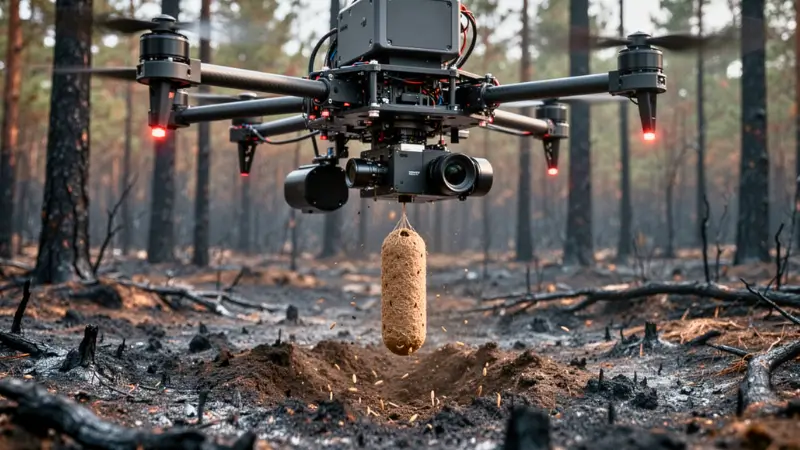
If your project covers 500 hectares or more, drone seeding platforms are worth a serious look. The market has expanded quickly — our full breakdown of 8 Drone Planting Systems That Slash Costs by 70% covers the wider field, but three companies stand out as category leaders right now.
Mast Reforestation operates out of the United States and runs a fully integrated service. Their drones do not simply drop bare seeds. They deploy engineered seed pucks that contain localized soil, nutrients, and pest deterrents built around your specific site.
They handle the entire chain from seed collection to flight operations, which makes them a strong fit for post-wildfire restoration and carbon credit projects where species selection matters as much as raw tree counts.
Flash Forest is based in Canada and focuses on raw planting speed. Their pod technology protects seeds through hard freezes, giving seedlings a better start in cold climates and boreal forests with short growing seasons. For teams that need to cover ground fast before the season closes, Flash Forest’s output rates are hard to beat.
Dendra Systems takes a data-driven approach from the United Kingdom. Before their drones drop a single seed, the company maps the site with ultra-high-resolution multispectral imaging.
Their software pinpoints the micro-sites where soil conditions give seeds the best chance. After planting, that same imaging tracks forest health year over year — a major advantage for carbon investors who need hard verification data.
The Numbers: Drones vs. Manual Planting Side by Side
| Metric | Drone Seeding | Manual Planting |
|---|---|---|
| Daily Output | 10,000+ pods per drone | 800–1,200 saplings per person |
| Survival Rate | 20–40% (compensated by volume) | 85–95% (precision placement) |
| Upfront Cost | High (tech lease, mapping) | Low (tools and saplings) |
| Ongoing Cost | Low (minimal crew on-site) | High (wages, camp, logistics) |
| Terrain | Steep, dangerous, inaccessible | Accessible, walkable ground |
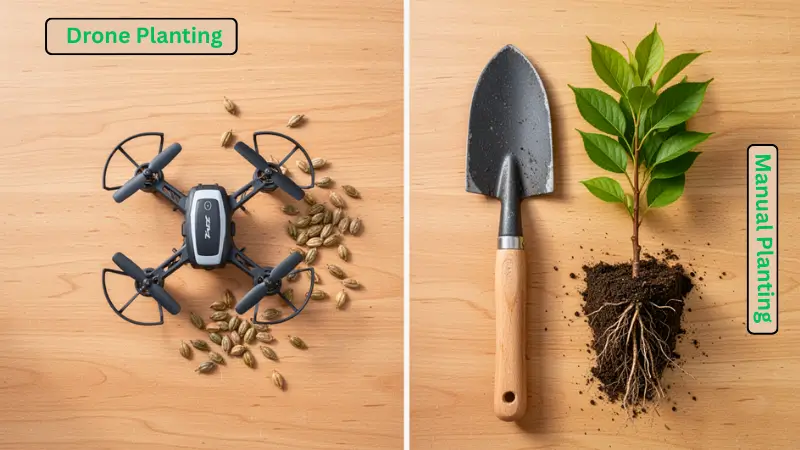
The survival rate gap looks alarming at first. Drone seeding averages 20–40% compared to 85–95% for hand-planted saplings. But drone operators compensate with sheer volume. If you seed 50,000 pods in a day and 35% survive, you still end up with 17,500 established trees. A crew of five planters working the same day might produce 5,000 saplings — even at a 90% survival rate, that is only 4,500 trees.
The math changes based on terrain, species requirements, and how long your planting window stays open.
Precision Manual Tools That Actually Work
Manual planting still wins on projects where biodiversity and survival rate are the primary goals. The right tools make a real difference to how many trees survive and how long planters stay healthy on the job.
The Pottiputki Planting Tube is the standard tool for planting containerized seedlings on soft to moderately firm ground. A planter drives the tube into the earth, presses a foot pedal to open the beak at the base, drops the seedling down the shaft, and moves on. The planter never bends over. Over a full day on sloped terrain, that upright posture prevents the fatigue that leads to sloppy planting and poor root contact.
Bushpro Hi-Baller Spades are built for ground where a tube cannot penetrate — rocky soil, root-heavy terrain, and steep inclines. The spade uses an offset handle design that keeps the tool close to the planter’s center of gravity, reducing the torque that causes lower back injuries on rough ground. These spades use high-carbon steel that holds an edge through thousands of strikes per shift.
Both tools cost under $200 to purchase, which makes the upfront equipment cost of manual planting genuinely low. The ongoing costs — wages, transport, food, and accommodation for a remote crew — add up fast.
What manual tools do well:
- Place saplings in the exact micro-site a planter chooses
- Deliver the highest possible survival rates
- Operate with minimal carbon footprint
- Require almost no mobilization cost on small projects
Where manual tools fall short:
- Physically demanding work leads to high crew turnover
- Logistically difficult to scale on remote or inaccessible land
- Cannot be used safely on steep post-wildfire cliff faces
- Far too slow for projects measuring in the hundreds of hectares
The Hybrid Strategy: Use Both
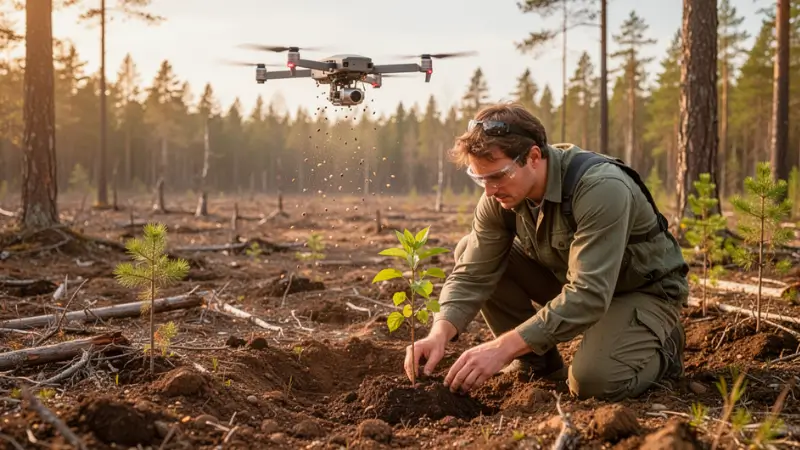
The most effective reforestation projects today do not choose one method and stick to it. They layer the two approaches according to what each stage of the project needs.
In the first phase, drone systems fly in and seed large areas with fast-growing pioneer species. These hardy trees stabilize the soil quickly, reduce erosion, and begin building shade cover. (If you want to compare platforms side by side before committing, see 8 Drone Planting Systems That Slash Costs by 70% for a detailed cost-per-hectare breakdown.) Once that foundation takes hold, manual crews move into the stabilized landscape and hand-plant the slower-growing, high-value climax species that give the forest its long-term biodiversity.
Once that foundation takes hold, manual crews move into the stabilized landscape and hand-plant the slower-growing, high-value climax species that give the forest its long-term biodiversity.
This staged approach reduces the average cost per tree while producing a forest that actually develops healthy structure over time. Drones handle the dangerous, inaccessible areas. Manual planters focus their effort and expertise where precision matters most.
Choosing Based on Your Project Size
Under 50 hectares: Stick with manual tools and local crews. Hiring a commercial drone team for a project this size will burn your budget on mobilization costs before a single seed hits the ground. Invest in quality spades and planting tubes, hire planters who know the terrain, and prioritize survival rate over planting speed.
50 to 200 hectares: Run a hybrid operation. Use drone mapping to understand the site before work begins — it will save time and money. Fly drones for pioneer seeding in the harder-to-reach sections, then send manual crews in to plant the ecological core of the forest where soil quality is highest.
500 hectares and above: Go autonomous. Managing a workforce large enough to cover this area by hand becomes a serious logistical problem. Between coordinating camp setup, crew transport, and daily output, you will spend as much energy running the operation as planting trees. Partner with a company like Mast Reforestation, Flash Forest, or Dendra Systems to hit the density you need before the season closes.
The Bottom Line
There is no single right answer here. Drones give you speed and access. Manual tools give you precision and survival rate. The project that ignores one entirely — on principle rather than evidence — usually pays for that decision later with either a blown budget or a failed forest.
Match the tool to the job. Start with your scale, assess your terrain, and decide what survival rate your project demands. From there, the right method becomes obvious. Drones vs. Hand-Planting: Which Reforestation Tools Are Right for Your Scale?
Frequent Ask Questions Related to Drone Planting vs. Hand-Planting
Which method costs less per tree — drone seeding or hand planting?
Drone seeding wins on cost per tree at a large scale. On projects above 500 hectares, drone operators typically deliver trees at 40–70% less than hand crews once you factor in labor, camp setup, and transport. On smaller projects under 50 hectares, hand planting stays cheaper because drone mobilization fees eat the savings fast.
Do drone-planted seeds actually survive long enough to grow into trees?
Yes, but the survival rate depends heavily on the pod technology the company uses. Basic aerial seeding delivers poor results. Advanced operators like AirSeed and Flash Forest use engineered seed pods packed with nutrients, pest deterrents, and moisture retention materials that push survival rates to 65–85% over three years — competitive with hand planting on many terrain types.
How many trees can one drone plant in a single day?
Output varies by system and terrain, but most commercial seeding drones deploy between 10,000 and 50,000 seed pods per day. MORFO’s systems can cover up to 50 hectares in a single day on open terrain. That compares to roughly 800–1,200 saplings per day from one experienced hand planter.
When does hand planting make more sense than drone seeding?
Hand planting makes more sense when your project is small (under 50 hectares), when you need specific biodiversity targets that require careful species placement, or when your terrain is flat and accessible. Planters read the soil in real time and choose the exact micro-site for each tree — a level of precision that current drone technology does not match.
What is the Pottiputki, and why do professional planters use it?
The Pottiputki is a Finnish-designed planting tube that lets workers plant containerized seedlings without bending over. The planter drives the tube into the ground, presses a foot pedal to open the base, and drops the seedling through the shaft. This upright planting posture reduces back strain dramatically, which means planters stay productive longer and plant each tree with better root-to-soil contact.
Do I need to buy drones to run a drone reforestation project?
No. Every major drone reforestation company operates as a full-service contractor. You hire them the same way you hire a construction crew — they bring the equipment, pilots, seed pods, and insurance. Your team handles site boundaries and basic ground checks. You never need to own or operate a single drone.