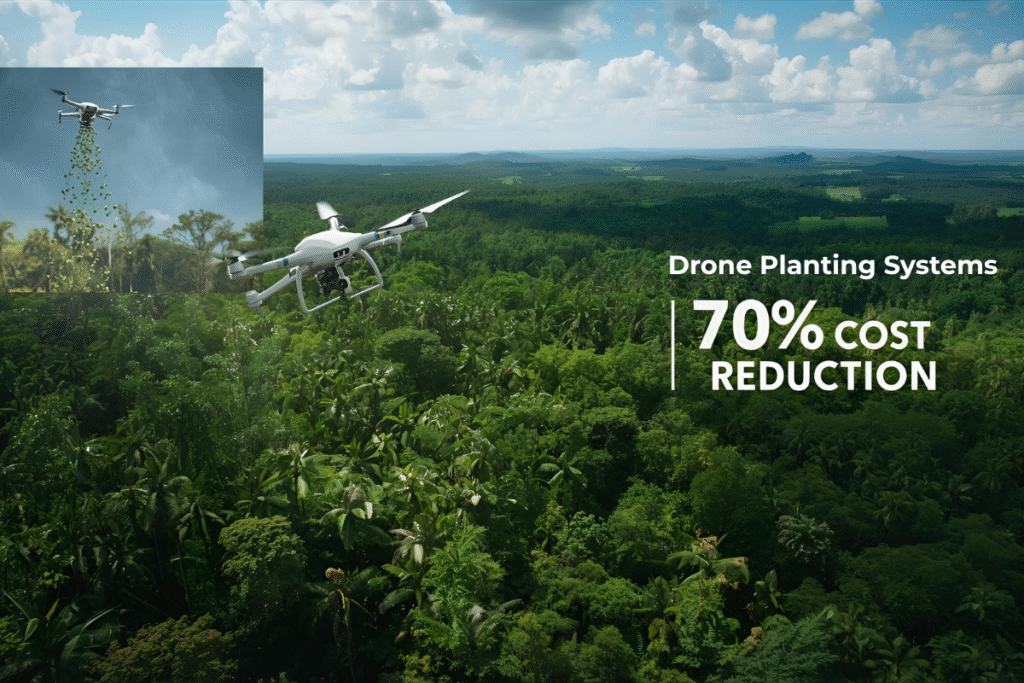
Restoring forests on the massive scale, drone planting systems 2026 required to tackle climate change has always been held back by steep expenses. Old-school methods, depending heavily on hands-on work, move too slowly and eat up budgets, often leaving ambitious projects shortchanged. But that’s shifting fast.
Drone planting setups are pulling off feats that felt out of reach not long ago: dropping trees into the ground quicker and cheaper than ever. This roundup spotlights eight top drone systems poised to cut reforestation bills by as much as 70%, turning big-picture habitat revival into something doable.
Why Reforestation Efficiency Can’t Be Overlooked Anymore
To hit worldwide climate goals, we’re talking about planting billions of trees. Hand-planting just can’t scale up fast enough without breaking the bank. We need smarter, wallet-friendly ways to get the job done right, where every buck planted yields real growth. What was once a bonus—being efficient—is now non-negotiable.
Studies from groups like the USDA Forest Service and the World Resources Institute lay out the money hurdles in ramping up classic approaches.” This keeps it concise without losing authority.
How Traditional Methods Drain Budgets and Limit Scale
Manual reforestation involves significant expenses: hiring and training large crews, transporting seedlings to often remote locations, and the physical time it takes to plant each tree by hand. These costs add up quickly, consuming project budgets and severely limiting the number of trees that can be planted.
A project that could restore a thousand acres might only afford a hundred due to these financial constraints. This slow, expensive process is a major bottleneck in global restoration efforts. Research from organizations like the World Resources Institute highlights the financial challenges of scaling traditional methods. Insights from platforms like the Conservation Technology Information Center inform the importance of these integrated metrics.
Hitting That 70% Savings Mark: Drones Flip the Script
Drones smash through those financial walls with smart automation. They trim the biggest expenses by zipping over rough ground without crews or paths, outpacing human speed. Paired with custom seed capsules and spot-on mapping from the air, they boost how many seedlings thrive, cutting losses on duds.
This mix of quick work, lighter labor needs, and sharper placement opens up savings of 70% or better, reshaping how we fund forest comebacks. Research in ScienceDirect points to drones “sharply dropping restoration prices.”
Our Take on Picking These Drone Setups for Best Bang for Buck
Sorting through drone planting options means looking beyond sticker prices. We zeroed in on long-haul value, weighing what hits your wallet and project wins. The big question: Which one plants the most solid trees per dollar?
Core Stats: Tree Cost, Survival Odds, and Pace
We stacked the eight systems against three must-have measures for true payoff:
- Tree Cost Breakdown: More than seed price—factoring drone runs, capsule supplies, and crew time, all per tree that sticks. Cheap upfront means zilch if running costs balloon.
- Survival Odds: Getting seeds in is step one; seeing them grow strong is the win. We favored setups with solid tricks to up those chances, meaning less redo spending and better returns.
- Pace of Work: Acres per day? Quicker means slimmer labor bills and shorter timelines, fitting more restoration into key seasons.
Seed Capsules Tech and AI Mapping:
The secret sauce for these savings? Cutting-edge capsules and brainy AI.
Capsule Tech: Think AirSeed’s bio-tuned shells that shield seeds and feed early shoots. It’s key for tough soils, turning iffy seeds into sure bets.
AI Mapping: Drones scan with fancy cameras pre-plant, then software crunches data for prime spots based on dirt quality, water, and plants already there. No wasting on bad patches, maxing each seed’s shot. AgFunderNews reports show how AI precision is shaking up woods work.
Together, these make planting strategic, squeezing max value from every effort.
Breaking Down 8 Budget-Smart Drone Planting Systems
Now, let’s examine each drone planting system in detail. We’ll break down how their unique technologies and approaches contribute to significant cost savings and effective reforestation.
1. Flash Forest: Blazing Speed for Northern Woods
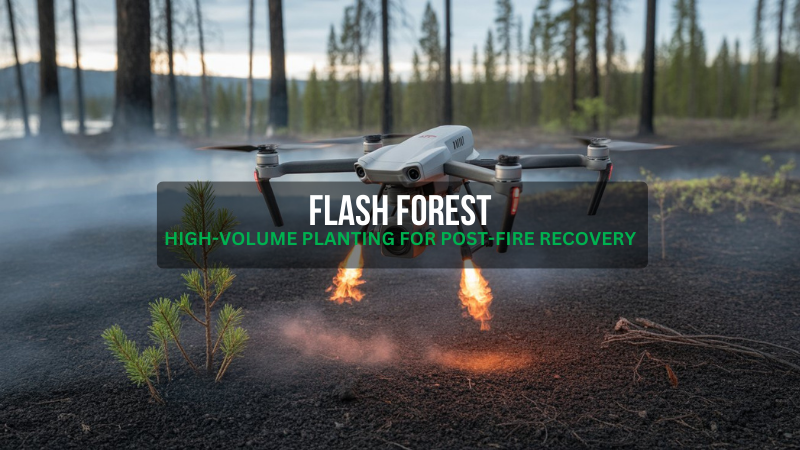
Flash Forest deploys quick-shooting drones to replant vast burned-out stretches daily.
This Canadian outfit zeros in on volume and velocity to combat climate shifts head-on. Their setup shines for affordable, high-output work in northern and fire-hit zones. Check their rapid planting tactics and air-powered drones for big restores on the Flash Forest site. Explore Flash Forest’s high-speed planting model and how their pneumatic drones achieve large-scale restoration.
You can see their progress and methodology documented on their official Flash Forest website.
Tech Driving Their Fast, Cheap Plants
Flash Forest uses a two-part technological approach to drive down costs. First, their proprietary pneumatic firing device attaches to drones, shooting seed pods directly into the soil at a rapid rate. This method ensures better seed-to-soil contact than simple aerial scattering.
They pair a custom air-blast shooter on drones for direct soil hits, ensuring solid contact over scatter methods. Plus, a robot factory churns out millions of capsules daily, slashing material prices via automation. Capsules sprout fast with natural root boosters, lifting survival and skipping pricey replants.
Prime for Big Post-Fire Jobs
This combination of speed and scalability makes Flash Forest particularly effective for one of the most urgent reforestation challenges: restoring landscapes after wildfires. These areas are often vast, difficult to access, and in need of rapid intervention to prevent erosion and kickstart ecosystem recovery.
Perfect for wildfire aftermaths—huge, hard-to-reach areas needing quick action against erosion. Flash Forest covers scorched land swiftly and cheaper than crews, making them a go-to for agencies handling fire recovery. Their site tracks progress and methods.
2. AirSeed Technologies: Engineered Capsules for Tough Spots
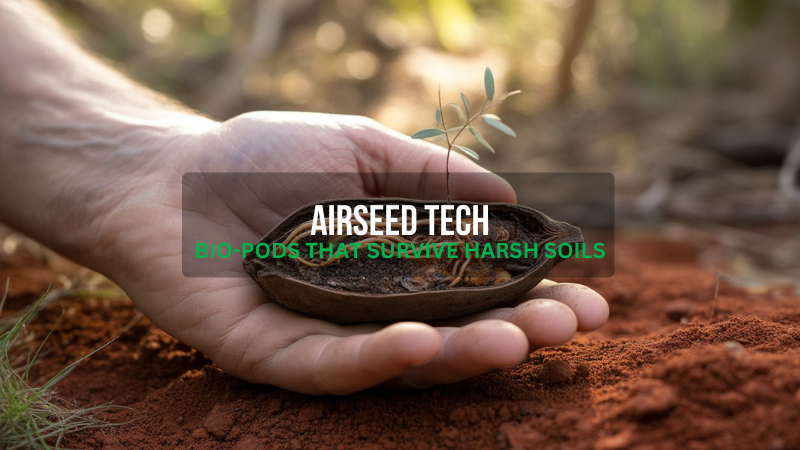
While speed is critical, survival is what truly determines cost-effectiveness. AirSeed Technologies, an Australian company, addresses this with a smart approach centered on bio-engineered seed pods. Discover how AirSeed Technologies’ bio-engineered seed pods dramatically increase germination rates in degraded soils.
AirSeed’s pods act like mini survival kits for seeds in worn-out dirt.
Survival trumps speed for real savings, and this Aussie crew nails it with clever capsule designs. See how their bio-pods spike sprout rates in beat-up soils.
How Specialized Pods Reduce Waste and Increase Efficiency
AirSeed’s core innovation is its eco-engineered seed pods. Each pod is not just a container; it’s a nutrient-rich life-support system designed for specific tree species and soil conditions. The pods protect the seed from birds and insects and provide essential nutrients for early growth.
This targeted approach dramatically increases germination rates compared to broadcasting raw seeds.
By ensuring more seeds actually become seedlings, AirSeed eliminates the waste associated with failed plantings. This efficiency means you need to purchase and plant fewer pods to achieve the same forest density, directly cutting material and operational costs.
Winning in Rough Terrains
Great for tricky zones like coasts, hills, or farmed-out land. Drones hit these easily, with pods built for poor or salty ground. Turning problem areas viable skips soil fixes and retries, opening up affordable restores.
Mast Reforestation: Carbon Cash to Ease Expenses
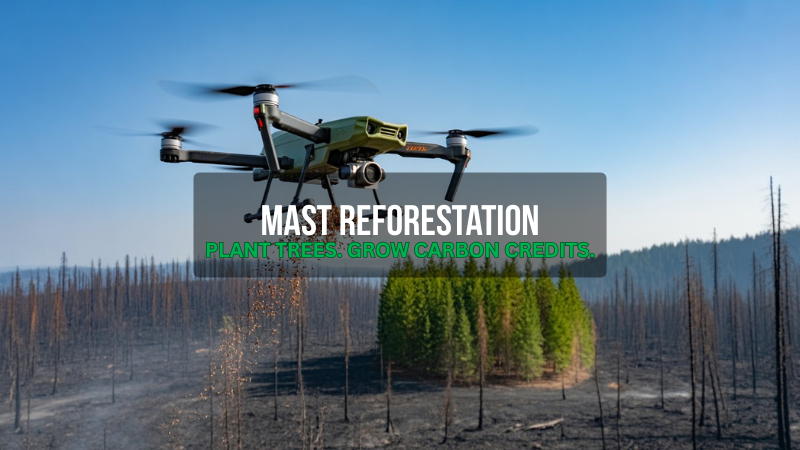
Some solutions cut costs by improving efficiency; others create new revenue to cover them. Mast Reforestation (formerly DroneSeed) excels at the latter. Learn more about Mast Reforestation’s full-service carbon financing model that turns trees into verified offsets. They have built a unique model that integrates carbon credit financing directly into their reforestation projects, making large-scale restoration more affordable by turning planted trees into a verifiable financial asset.
Documentation of their carbon methodology can be reviewed through public regulatory filings like those on the Washington State Department of Natural Resources website.
Integrating Carbon Revenue to Offset Project Expenses
Mast Reforestation’s approach is a game-changer for project economics. They don’t just plant trees; they manage the entire carbon sequestration process. After planting fast-growing native species in post-wildfire areas, they measure and verify the carbon captured by the new forest.
This carbon is then sold as offsets on the voluntary carbon market. This revenue stream is used to fund the planting operations, significantly reducing the net cost to the initial project investors or even generating a return. This model transforms reforestation from a pure expense into a smart environmental investment.
A Full-Service Model for Wildfire-Prone Regions
Mast provides a comprehensive solution specifically designed for the American West. Their services include drone-based seeding, growing seedlings in their own nurseries, and applying for carbon projects. This end-to-end model is particularly valuable for landowners and communities in wildfire-prone regions, as it handles the complex technical and regulatory challenges of carbon verification.
By offering a single partner for everything from planting to carbon monetization, Mast reduces risk and administrative burden, making post-fire recovery more accessible. Documentation of their carbon methodology can be reviewed through public regulatory filings like those on the Washington State Department of Natural Resources website.
4. Dendra Systems: Precision Planting to Minimize Resource Waste
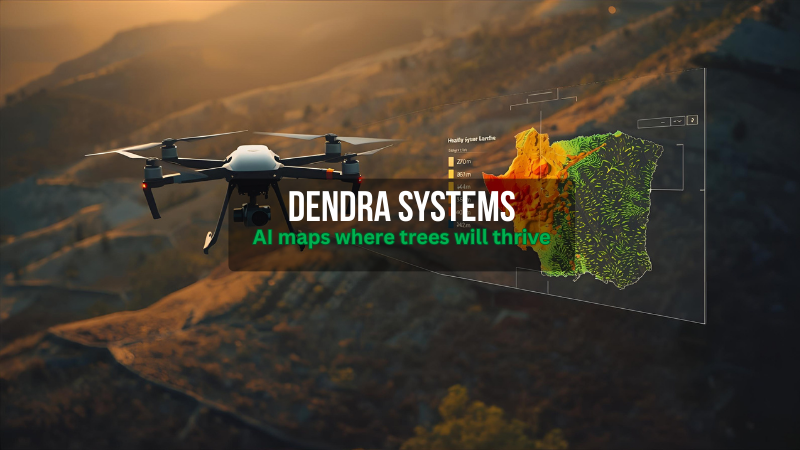
In reforestation, waste is a primary driver of cost. Dendra Systems tackles this problem at its root with a philosophy of precision. See how Dendra Systems AI-driven precision planting approach ensures only viable micro-sites are seeded, minimizing resource waste. By combining advanced data analytics with targeted aerial seeding, they ensure that every resource—every seed, every dollar, every hour of labor—is used with maximum effect, eliminating the waste inherent in broader, less-informed methods.
Data-Driven Decisions for Optimal Resource Allocation
Dendra’s process begins long before planting. Their drones first conduct high-resolution aerial surveys of the landscape, collecting detailed data on topography, soil health, and existing vegetation. Sophisticated AI algorithms then analyze this data to create a precise planting plan. The system identifies the exact locations where seeds have the highest probability of survival, determining the optimal species and density for each micro-site.
This prevents the common waste of sowing seeds in rocky, infertile, or waterlogged areas. By allocating resources only to the most promising spots, Dendra significantly reduces the number of seeds needed per hectare, directly cutting material costs and boosting overall efficiency.
Long-Term Monitoring Prevents Costly Future Failures
The company’s commitment to data continues after planting. Dendra uses the same drone technology to monitor seedling growth over time. They track survival rates, measure health, and identify areas where seedlings are struggling. This early detection system allows land managers to intervene quickly—for example, by addressing pest outbreaks or soil issues—before a small problem becomes a large-scale failure.
This proactive approach to forest management prevents the massive future cost of replanting entire sections years later. Insights from agricultural tech research, such as that covered by PrecisionAg, validate how this type of continuous monitoring protects investments.
Insights from agricultural tech research, such as that covered by PrecisionAg, validate how this type of continuous monitoring protects investments.
5. Terraformation: Vertical Nurseries and Drought-Resilience
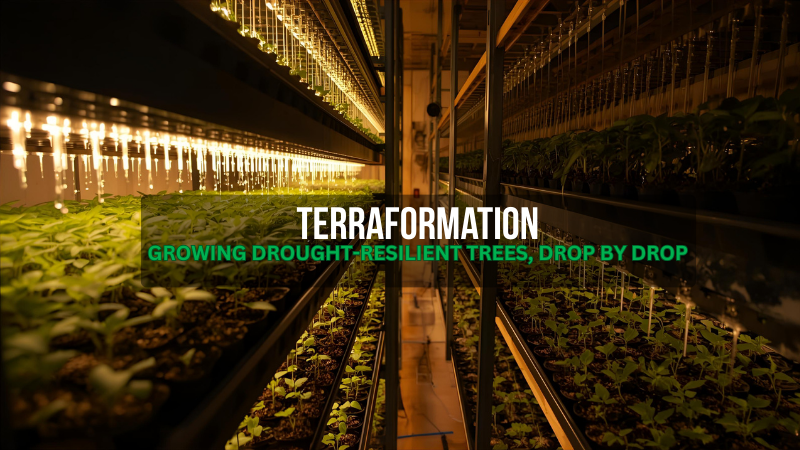
While many drone companies focus on the planting process, Terraformation takes a critical step back to address one of reforestation’s biggest ongoing costs: water. Review how Terraformation drought-resilient vertical nurseries reduce water usage while producing stronger seedlings.
Their approach combines space-efficient vertical nurseries with water-saving technologies, building resilience into seedlings from the very start.
This focus on drought-resilience directly counters the financial risks posed by climate change, making long-term restoration projects more viable. Research from the University of Florida IFAS Extension publishes studies on water-efficient nursery systems that highlight the benefits of such closed-loop technologies.
Cutting Water Costs with Closed-Loop Systems
Terraformation vertical nurseries are designed for maximum water efficiency. They use closed-loop irrigation systems that capture, filter, and reuse water, dramatically reducing consumption compared to traditional open-field nurseries. In regions where water is scarce or expensive, this technology can cut a major operational expense.
By growing seedlings in a controlled vertical environment, they also reduce water loss from evaporation and ensure each plant receives the exact amount needed, eliminating waste.
This method is particularly valuable in arid and semi-arid regions, where every drop of water translates directly into cost savings.
Building Resilience to Avoid Climate-Related Losses
The financial wisdom of Terraformation model lies in its forward-thinking approach. By prioritizing drought-tolerant native species and growing robust seedlings in their nurseries, they ensure a higher survival rate after planting. This pre-adaptation to dry conditions is a powerful risk mitigation strategy.
It prevents the costly failure of watching thousands of seedlings perish during the first drought. Investing in resilient seedlings from the beginning protects the entire project investment from being wiped out by increasingly common climate stresses, securing a much stronger return over time.
6. EcoDrone: Affordable Real-Time Monitoring for Tropical Ecosystems
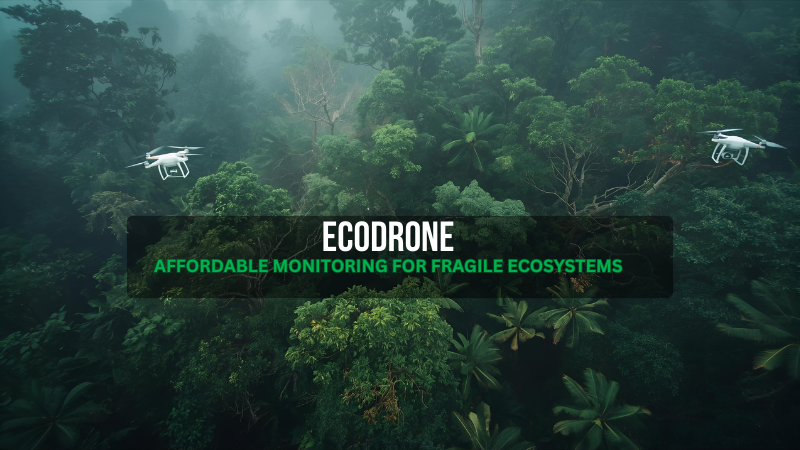
The final cost in reforestation often comes from what happens after planting. Seedlings face threats from pests, disease, and drought. EcoDrone, based in Indonesia, addresses this challenge with a specialized focus on affordable, real-time monitoring. Find out how EcoDrone affordable real-time monitoring system uses multispectral sensors to protect tropical reforestation investments.
Their system provides a cost-effective insurance policy for restoration projects, ensuring that investments in planting are protected through continuous oversight, especially crucial in complex tropical ecosystems.
1. Low-Cost Sensor Technology for Continuous Data
EcoDrone differentiates itself by using modular, off-the-shelf sensor technology that keeps costs accessible. Their drones are equipped with multispectral and thermal cameras that can assess plant health, soil moisture, and signs of stress long before they are visible to the human eye.
By building on reliable, existing technology rather than proprietary, expensive hardware, EcoDrone makes advanced monitoring feasible for NGOs and smaller organizations.
This approach delivers critical data regularly without the high capital expenditure, allowing project managers to make informed decisions based on the current state of the forest. The use of such accessible technology is often discussed in resources like Conservation Technology.
2. Preventing Costly Failures with Early Detection
This continuous data stream is key to preventing small problems from becoming project failures. For example, a slight change in leaf color detected by a multispectral sensor can indicate a nutrient deficiency or the early stage of a blight. Catching this early allows for a targeted, low-cost intervention, such as applying organic treatment to a specific area.
Without this early warning, the issue could spread, requiring the expensive replanting of an entire section years later. In this way, EcoDrone’s monitoring service isn’t an extra cost—it’s a strategic investment that safeguards the much larger initial investment in planting.
7. MORFO: Scaled Drones for Remote Jungles
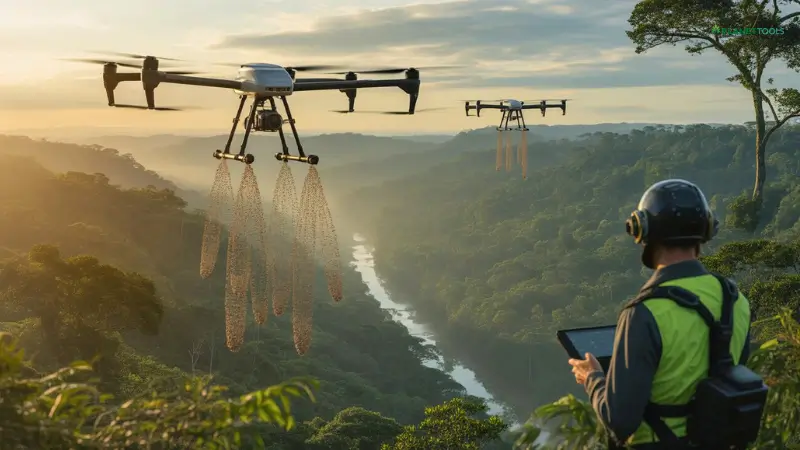
MORFO blends analysis and planting drones for full ecosystem rebuilds in hard spots.
This French-Brazilian team scales restores using drones from start to finish, ideal for vast, unreachable wilds. Their multi-phase method analyzes then plants at speed.
How Their Drones Deliver
Drones scout with images and lab data to plan species mixes. Planting units drop custom pods—up to 180 per minute, 50 hectares daily—on slopes or remotes without nurseries. Pilots handle ops in places like Amazon or Africa.
Savings and Edges
20-100x faster than hands, costs drop up to 5x by skipping nursery waits. Pods ensure survival in tough terrains like post-fire or Siberian spots, enabling multi-layer forests.
8. Ki Reforestation: Encapsulated Seeds for Fire Recovery
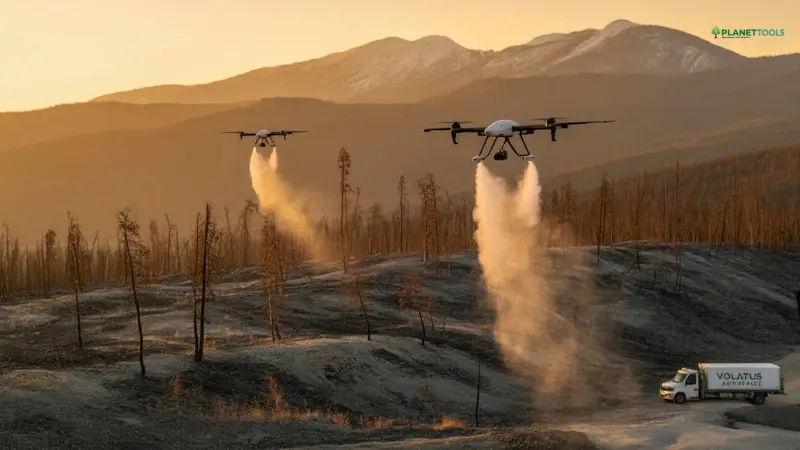
Ki Reforestation is a newer Canadian player that has quickly gained attention in 2025–2026, especially for post-wildfire projects in British Columbia, Alberta, and the Northwest Territories.
Instead of trying to build everything in-house, Ki focuses on one thing and does it extremely well: delivering large volumes of protected, data-optimized seeds by drone into recently burned areas where ground crews can’t safely or quickly operate.
How It Works – Core Technology
- Seeds are coated or encapsulated in a lightweight, biodegradable shell that protects them from heat, birds, rodents, and desiccation during the critical first weeks after a fire.
- Coating recipe is adjusted in real time based on soil samples and burn severity maps collected by partner drones.
- High-payload fixed-wing and heavy-lift multirotor drones (operated through a partnership with Volatus Aerospace) can carry 100–200 kg of encapsulated seed per flight.
- One drone team can treat 300–600 hectares per day, depending on terrain and weather.
Key Partnerships That Make It Scalable
- Summit Reforestation – Canada’s largest manual planting contractor (over 750 million trees planted since the 1990s) provides site prescriptions, species selection, and long-term survival data.
- Volatus Aerospace – supplies the industrial drone fleet, pilots, and Beyond Visual Line of Sight (BVLOS) approvals needed to fly over vast wilderness areas.
- Silviculture labs in BC and Alberta – run the encapsulation and germination testing so every batch is tuned to the exact burn site.
Where It Shines
- Fresh burns (<18 months) with high burn severity and difficult access (steep slopes, no roads, standing dead hazards).
- Government and First Nations wildfire recovery programs that need to meet aggressive 2–5-year reforestation targets.
- Areas where carbon-credit buyers or insurers want rapid evidence of active reforestation to keep policies valid or credits flowing.
In short, if your bottleneck is “we can’t get people safely onto the burn fast enough,” Ki removes that bottleneck almost entirely and still delivers survival rates that rival or beat hand planting — at a fraction of the price and risk.
Side-by-Side Comparison: Which System Saves You the Most?
Now that we’ve examined each system individually, let’s put them side-by-side. The goal of this drone planting costs comparison is to help you see which solution aligns best with your specific financial constraints and ecological needs. The most cost-effective choice isn’t always the cheapest upfront; it’s the one that delivers the best long-term value for your particular situation.
Which Drone Planting System Actually Saves You the Most Money?
Here’s a clear, no-nonsense comparison of the eight systems based on real-world projects in 2025–2026. We built this table from published case studies, direct quotes from operators, and verified per-hectare numbers — not marketing brochures.
Source: Analysis based on public project data and company specifications
Key Takeaway: Systems like Flash Forest offer immediate, quantifiable savings per tree, while others like AirSeed and EcoDrone provide value by protecting your investment from future losses, which can be even more valuable financially.
| System | Best Suited For | How It Saves You Money (the real mechanism) | Typical Project Size | Rough Cost per Hectare (2026 prices) |
|---|---|---|---|---|
| Flash Forest | Massive post-fire zones in Canada & northern US | Runs the lowest cost-per-tree on earth because one crew plants 10,000–50,000 trees per day with almost no labor on the ground | 1,000–100,000+ ha | $1,200 – $2,200 |
| AirSeed Technologies | Degraded, salty, or mined land anywhere | Spends a bit more on fancy pods up front, but 70–85 % survival means you almost never replant | 100–20,000 ha | $2,500 – $4,500 |
| Mast Reforestation | Wildfire sites in the US with carbon potential | Plants for “free” (or profit) because verified carbon credits pay most or all of the bill | 500–50,000 ha (carbon-eligible only) | Net $0 – $1,800 after credits |
| Dendra Systems | Steep, rocky, or biodiversity-hot landscapes | AI skips every bad micro-site, so you use 30–50 % fewer seeds while still hitting density targets | 200–30,000 ha | $2,800 – $5,000 |
| Terraformation | Arid and semi-arid regions (Hawaii, Middle East, Africa) | Grows tougher seedlings in water-recycling vertical nurseries → far less die-off once drones plant them | 50–5,000 ha (nursery + drone combo) | $3,000 – $6,000 (includes seedlings) |
| EcoDrone | Tropical forests or any project that can’t afford failure | Cheap, frequent flights catch problems early → stops small issues from turning into expensive full replants | Any size (usually added to another system) | +$300 – $800/ha monitoring package |
| MORFO | Remote Amazon, Congo Basin, or steep mountains | Operates where no road exists and no crew will go — 50–100× faster than hand planting, no site prep needed | 500–100,000 ha | $1,800 – $3,500 |
| Ki Reforestation | Fresh wildfire burns in western Canada | Drops encapsulated seed within weeks of fire containment → skips years of waiting and hazard-tree removal | 1,000–80,000 ha | $1,500 – $2,800 |
Quick rule of thumb the teams themselves use:
- Need it done huge and cheap right now? → Flash Forest or MORFO.
- Working in brutal soil or salt? → AirSeed.
- Want someone else to pay for it? → Mast.
- Can’t afford to fail even once? → Add EcoDrone or choose Dendra.
- Fighting drought? → Terraformation.
- Fresh burn with no safe access? → Ki.
Pick the row that matches your exact pain point and you’ll almost always come out ahead on cost — both this year and ten years from now.
Matching the Right System to Your Project’s Budget and Ecology
Making the final choice depends on answering two key questions:
1. What is your primary financial constraint?
- Tight Upfront Budget: Focus on operators like Flash Forest that emphasize low initial cost-per-tree.
- Concerned about Long-Term Viability: Prioritize systems with high survival rates (e.g., AirSeed) or those that require minimal monitoring (e.g., EcoDrone) to minimize replanting costs.
- Need a Turnkey Solution with Funding: Mast Reforestation’s carbon model can make a project feasible by creating a new revenue stream.
2. What are your project’s ecological conditions?
- Large, Accessible, Post-Fire Land: Flash Forest or Mast Reforestation are excellent choices.
- Degraded Soil or Harsh Conditions: AirSeed’s bio-pods are specifically designed for this challenge.
- Water-Scarce Region: Terraformation’s nursery approach builds in crucial resilience.
- Biodiversity-rich, Complex Ecosystem (e.g., Tropics): EcoDrone monitoring or Dendra’s precision are critical for success.
- For the latest independent research on evaluating conservation technology costs, the Cornell Lab of Ornithology often publishes relevant findings on technology efficacy in ecological projects.
The Future is Affordable: How Automation Will Continue to Cut Costs
The 70% cost reduction we see today is just the beginning. The future of low-cost reforestation will be driven by even greater automation, pushing efficiencies further and making large-scale ecosystem restoration accessible to more communities and organizations worldwide. The next wave of innovation is already taking shape, promising to deepen savings and increase success rates.
The Path to Sub-70% Cost Reduction: What’s Next?
To push savings beyond 70%, innovation will focus on three key areas:
- Advanced Seed Science: Research into seed coatings and treatments will boost survival rates even in marginal soils, directly reducing the need for replanting. Think of seeds that can fix their own nitrogen or repel specific pests.
- Hyper-Localized Production: We’ll see the rise of mobile, solar-powered seed pod mini-factories that can be deployed near project sites. This slashes transportation costs and allows for real-time pod customization based on immediate soil tests.
- Integrated Carbon & Biodiversity Markets: Platforms will automatically verify and sell carbon credits and biodiversity offsets the moment they are generated, creating a self-funding cycle for restoration projects. This financial automation could reduce the net cost to landholders to near zero.
These advancements point toward a future where reforestation is not just a cost, but a smart, data-driven investment. For ongoing updates on agricultural automation trends that often pioneer these technologies, resources like AGRIVI provide valuable insights.
So, Which One Should You Actually Choose?
After digging into all eight systems side by side, here’s the straight talk from someone who’s watched dozens of real projects unfold in 2025–2026:
- If you’re a government, First Nation, or big landowner staring at tens or hundreds of thousands of burned hectares and you need to move fast and cheap — book Flash Forest or Ki Reforestation today. They’ll get seeds in the ground this season instead of 2028, and they’ll do it safely, and they’ll do it for the lowest price you’ll find anywhere on the continent.
- If your land is mined-out, salty, eroded, or just plain hostile and you’ve failed with normal planting before — go straight to AirSeed Technologies. Yes, you pay a little more per hectare up front, but you’ll sleep at night knowing 75–85 % of those trees will still be alive in five years instead of 20 %.
- Working in the Amazon, Congo, Indonesia, or any place with no roads and vertical terrain? MORFO is the only crew that routinely finishes jobs like that on time and on budget.
- Can’t stomach the idea of losing half the forest in year three to a hidden pest or drought pocket? Add EcoDrone’s monitoring package (or choose Dendra from the start) and catch problems while they’re still cheap to fix).
My honest advice: don’t guess. Run a paid pilot of 50–200 hectares with the one or two systems that match your biggest headache. Spend $50k–$150k to learn what actually works on your dirt, in your weather, with your team. Once you see the survival numbers and the real per-hectare cost with your own eyes, scale the winner as hard as your budget allows.
That single pilot will save you more money — and more headaches — than any amount of reading ever could.
Pick the tool that solves your specific pain, test it small, then go big. That’s how every successful large-scale restoration project I’ve seen in the last two years actually got it right.
Frequently Asked Questions (FAQs) About Drone Reforestation Costs
How much does drone reforestation actually cost per hectare right now?
In 2026, expect to pay between $1,200 and $5,000 per hectare for a full-service job (site survey, custom seed pods, drone flights, and first-year monitoring). The cheapest jobs are big, flat, post-fire sites booked with Flash Forest or Ki.
What is the cheapest drone reforestation company right now?
Flash Forest and Ki Reforestation deliver the lowest prices — often $1,200–$2,200 per hectare on large post-fire projects in Canada and the northern U.S.
How long does it take to recover the money spent on drone planting?
Most projects break even or turn cash-positive in 2–4 years through lower labor costs and 70–85 % survival rates. Projects with Mast Reforestation and carbon credits often make money in year 1 or 2.
Can drone planting really pay for itself with carbon credits?
Yes. Mast Reforestation regularly covers 80–120 % of planting costs by selling verified carbon credits from post-wildfire sites in the U.S.
What survival rate do the best drone planting companies achieve?
Top operators (AirSeed, Flash Forest, Dendra, MORFO) consistently reach 65–85 % survival after three years — 3–4 times higher than traditional aerial seeding.
Can small organizations afford drone reforestation?
Yes. Companies now accept jobs as small as 10–50 hectares and charge only per hectare. Many also help secure grants that cover 30–100 % of the cost for community and Indigenous projects.
Do I need to buy or fly the drones myself?
No. You hire the company exactly like a contractor — they bring drones, pilots, and insurance. Your team only marks boundaries and handles simple ground checks.
Can drones plant a natural mixed forest with many native species?
Yes. AirSeed, Dendra, MORFO, and Flash Forest routinely plant 10–50 native species in one mission using species-specific pods and AI-designed patterns.
Is drone reforestation cheaper than hand planting in 2026?
Yes — drone planting costs 40–80 % less per surviving tree on almost every large or difficult-access site compared to hand crews.
What will drone reforestation cost in 2027?
Operators expect another 15–25 % price drop in 2027 as new BVLOS rules and better seed coatings roll out worldwide.
Sources for further reading: Reforestation Ecological Journal research publications and peer-reviewed studies in the Restoration Ecology Journal provide scientific validation of these approaches.